What is being treated as a new scandal in Burgenland in 2026 is more than a hundred years old. The asbestos-bearing serpentinite of the Rechnitz window was documented, mined, marketed as a raw material, medically studied and argued in court long before the first Greenpeace sample tube was filled. At almost every point in this history, the knowledge was already there. At almost every point, it did not lead to decisive action.
That this region contains asbestos-bearing rock is geologically expected (we explain the mineralogy of the serpentinite on the overview page). The geologist Friedrich Koller of the University of Vienna told Falter: „Asbest bildet sich in den Klüften", and went on: „In manchen Steinbrüchen, wie in Badersdorf, sind Asbestadern häufiger als in anderen Serpentinit-Steinbrüchen." (Asbestos forms in the fissures. In some quarries, such as Badersdorf, asbestos veins are more frequent than in other serpentinite quarries.) The question was never whether the asbestos is there. It was what was done with the rock.
The raw material: 1916 to 1945
At first the Rechnitz asbestos was not a by-product but the product. Between 1916 and 1945 it was mined industrially as a raw material in the Rechnitz-Bernstein region. In 1926 the deposit near Rechnitz belonged to a dedicated AMIANT-Aktiengesellschaft; unpublished geological reports from that period came from C. Doelter ("The asbestos and talc deposits in Rechnitz", 1922) and O. Ampferer (report on the AMIANT-AG asbestos deposit near Rechnitz, 1926).
How rich the deposit was considered to be was recorded in 1928 by the Viennese Kommerzialrat Heinrich Rosenberg in the Berg- und Hüttenmännisches Jahrbuch: the „Anteil am asbesthaltigen Material in der gesamten Gesteinsmasse" (share of asbestos-bearing material in the whole rock mass) was 25 to 80 percent, „im Durchschnitte über 50%" (on average over 50%). This is the share of asbestos-bearing material in the rock mass, not the asbestos content; the figure is therefore not directly comparable with the quarry-specific asbestos contents that the agriculture ministry gave in 2026 for the four sealed quarries (2 to 100 percent). In the Montanistische Rundschau in the mid-1930s Rosenberg, signing as a partner in the micro-asbestos firm Bernfeld & Rosenberg, wrote that "micro-asbestos" from Burgenland could be delivered to Germany at very low prices and duty-free. The article explicitly promoted it as a filler for asphalt and road building, and a leaflet on the construction of rolled asphalt surfaces from July 1933, quoted in it, even named asbestos powder among the fillers eligible under the DIN specifications.
The reach of this trade is documented cartographically.
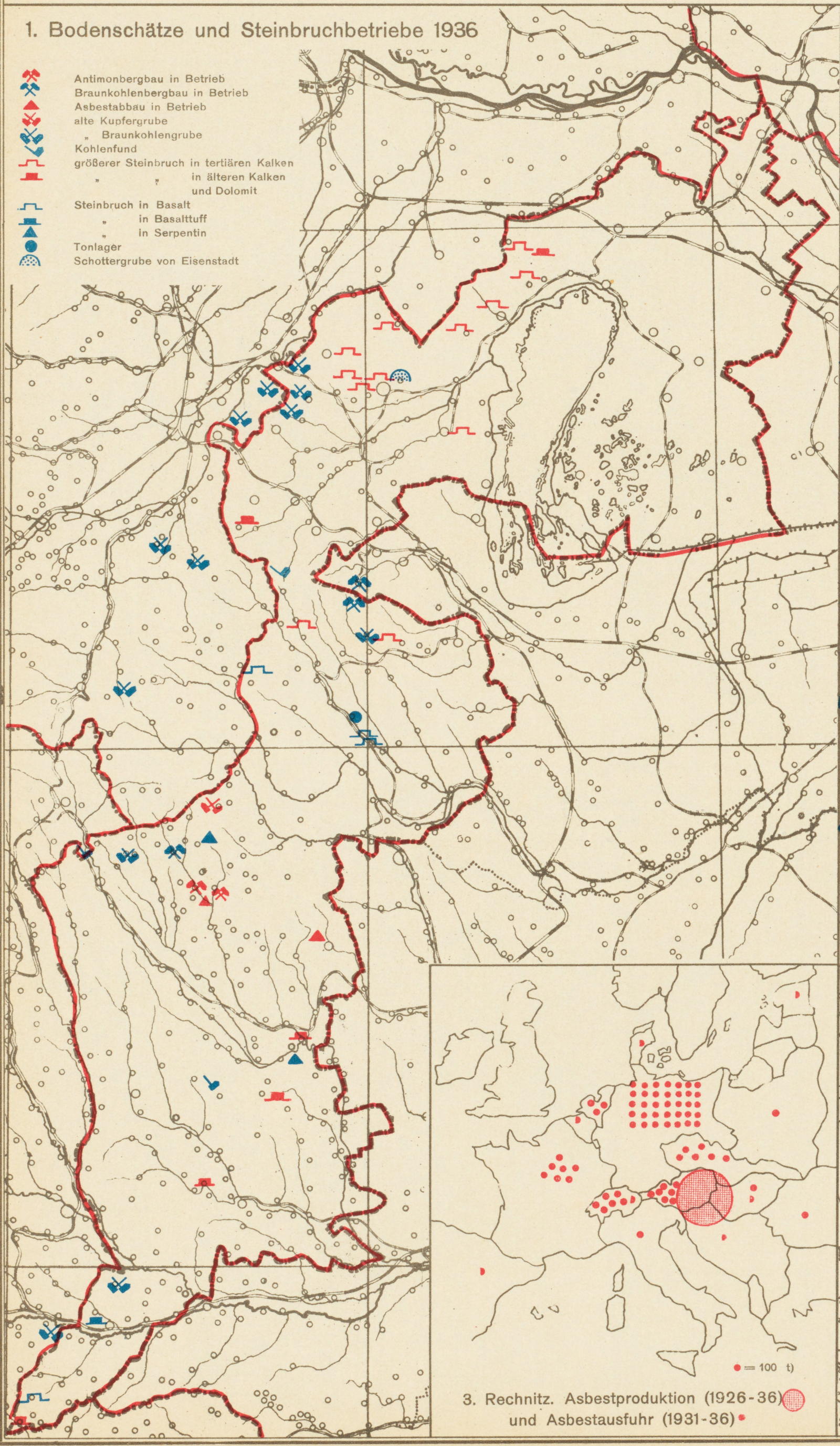
In 1938 H. Eggenberger reported on „Nachforschungen nach Asbestlagerstätten in Österreich" (searches for asbestos deposits in Austria) by the Deutsche Asbestzement-A.G. in Berlin-Rudow and the Eternit works of Ludwig Hatschek in Vöcklabruck; whether this unpublished report deals with the Rechnitz deposit cannot be told from the bibliography of the Geological Survey of Austria, which lists it under Austria in general. Two reports by H. Leitmeier on the asbestos deposit in the Bernstein serpentinite body followed in 1943. Targeted asbestos mining ended in 1945; the asbestos in the rock remained.
The warning: Rechnitz, 1965 to the 1980s
An early medical warning came from the population itself. In 1965 the Rechnitz mason B. J. was admitted to the lung sanatorium at Hirschenstein with severe pneumonia. On the X-rays the doctors found meandering calcifications of the pleura, so-called pleural plaques. They are regarded as an indicator of asbestos exposure: according to the Helsinki criteria, in regions where plaques are not endemic, 80 to 90 percent of radiologically well-defined plaques are attributable to occupational asbestos exposure, and low exposures from work, the household or natural sources can also induce them (Tossavainen 1997). The mason had never worked in any of the asbestos pits.
Reviewing further records of the sanatorium, the physicians found 24 more X-rays with identical pleural plaques, all in patients from Rechnitz, 18 of them with no occupational asbestos exposure at all. The Federal Ministry of Health and Environmental Protection then sent doctors and scientists in the early 1970s. A large study examined the population in three tranches, two years apart. The result was unambiguous: about 10 percent of 300 examined Rechnitz residents showed the asbestos-typical calcifications. In a control group of 600 people from other Burgenland municipalities: nobody. A 68-year-old pensioner, a housewife and vineyard worker who had never worked in a mine, was diagnosed with advanced asbestosis.
In parallel, researchers at the University of Natural Resources and Life Sciences (BOKU) Vienna looked for the source. They analysed the soil of the vineyards, the water of the household wells, the dust from house roofs. They found asbestos everywhere. On 15 April 1979 they measured 3,350 asbestos fibres per cubic metre in the air of Rechnitz, not at a contaminated workplace but, as Falter puts it, „in der freien Natur" (out in the open countryside). In their research report from the early 1980s the authors recorded where the burden came from: from the natural weathering of the stony soil and from the fact that the Rechnitz roads had been „zum Teil mit ‚Asbesthältigem Gestein' geschottert" (gravelled in part with "asbestos-bearing rock"); tyre abrasion had carried the fibres into the air. Asbestos-bearing building sand had also been used.
The parallel with 2026 lies in the route of spread: even then, Rechnitz roads had in part been gravelled with asbestos-bearing rock, and the burden fell on people who had never worked with asbestos. The Falter editor Matthias Winterer summed it up in 2026: „Von der Gefahr weiß man jedenfalls schon lange. Aber statt die Ergebnisse der Rechnitz-Studie näher zu studieren, blieben sie im Burgenland unbeachtet. Sie hätten eine Warnung sein können." (The danger has been known for a long time. But instead of studying the Rechnitz results more closely, they went unheeded in Burgenland. They could have been a warning.) In the same piece Falter reports an analysis of sand from the Pilgersdorf quarry by a private civil-engineering office in Vienna: the asbestos content of the sample was 8.86 percent, nearly ninety times 0.1 percent by mass. From that share upwards, waste containing a substance classified as a category 1A carcinogen, such as asbestos, is to be classed as hazardous in Austria (Abfallverzeichnisverordnung 2020, Annex 3, HP 7).
Looking away: 1990 to 2011
In 1990 Austria issued the Asbestos Ordinance (Asbestverordnung, BGBl. Nr. 324/1990). It defined as asbestos six mineral fibres of the serpentine and amphibole groups (chrysotile as well as actinolite, amosite, anthophyllite, crocidolite and tremolite), treated substances, preparations and finished goods with „mehr als 0,1 Masseprozent Asbest" (more than 0.1 percent asbestos by mass) as asbestos-containing, and banned products containing amphibole asbestos as well as a list of chrysotile products, among them „Boden- und Straßenbeläge" (floor and road surfacings); its text contains no restriction to intentionally added asbestos. In a letter of 10 May 1995 (more on this below), the environment ministry held that gravel was to be classed as a substance under the Chemicals Act and that for gravel „grundsätzlich die Asbestverordnung anwendbar" (the Asbestos Ordinance is in principle applicable). The Asbestos Ordinance expired at the end of 31 December 2003. Since 1 January 2004, asbestos has been governed by § 2 of the Chemicals Prohibition Ordinance 2003 (Chemikalien-Verbotsverordnung 2003, BGBl. II Nr. 477/2003). It names the same six mineral fibres and prohibits placing the fibres themselves on the market and using them, as well as the manufacture, placing on the market and use of substances, preparations and finished goods to which the fibres are intentionally added.
The same six fibres and the same restriction are found in EU law: REACH, Annex XVII, entry 6, prohibits the manufacture, placing on the market and use of the fibres and of articles and mixtures to which they are added intentionally. Products that contain asbestos fibres unintentionally, for instance through natural occurrence, are exempt from it according to the agriculture ministry. According to the same answer they are nevertheless not unregulated: if asbestos-bearing rock is placed on the market as a substance or mixture, its hazard must be communicated visibly under the CLP Regulation, the threshold for classifying a mixture as carcinogenic typically being 0.1 percent by mass. Annex XVII, entry 28, which governs the sale of carcinogenic substances and mixtures to the general public, may also become relevant; supply to professional users is permitted under that entry, and the ministry calls the classification of untreated natural materials challenging in enforcement practice. At EU level, it says, there are efforts to extend entry 6 to naturally occurring asbestos. The ministry sees no legal gaps (4055/AB-BR/2026).
The provincial task force, by contrast, called the legal position a grey area in 2026, according to Falter: placing asbestos-bearing materials on the market had been prohibited since 1990, but only where the fibres had been added intentionally; a rule for naturally occurring asbestos was lacking. The restriction to intentionally added fibres is found in the Chemicals Prohibition Ordinance of 2003; it is not found in the text of the 1990 Asbestos Ordinance.
The two decades after 1990 are a chain of findings and inaction. In 1994 the Zentrum für Elektronenmikroskopie in Graz (ZFE) identified chrysotile and actinolite in samples from the Bernstein quarry; according to Falter it warned that the „bei der Handhabung und beim Transport (…) entstandene Abrieb" (abrasion produced during handling and transport) was to be classed as „schwach gebundener Asbest" (weakly bound asbestos) and represented an „erhöhtes Gesundheitsrisiko" (increased health risk).
In 1995 two strands ran side by side: a letter from the environment ministry and a report for the labour inspectorate. On 10 May 1995 the Federal Ministry for the Environment wrote to the district authority Oberwart, subject „Asbestverordnung, BGBl.Nr. 324/1990; Asbesthältiger Schotter" (Asbestos Ordinance, BGBl. Nr. 324/1990; asbestos-bearing gravel). According to the enclosed report of the district authority, „durch Probennahmen in diesem Schotter Asbestanteile von mehr als 0,1 Masseprozent festgestellt" (sampling in this gravel had found asbestos contents of more than 0.1 percent by mass). The letter names no quarry; Falter attributes it to the Bernstein quarry. Whether the gravel was banned depended, according to the letter, „nicht nur von seinem Masseanteil an Asbest, sondern auch von der Art der in ihm enthaltenen Mineralfasern" (not only on its mass share of asbestos but also on the type of mineral fibres it contains). As an instrument, the letter named § 360 para. 4 of the Trade Regulation Act 1994 (Gewerbeordnung 1994, GewO), the interim coercive and safety measures up to the closure of the business. As a preliminary question, it said, it had to be examined whether the installations in the quarries were commercial operating facilities within the meaning of § 74 para. 1 GewO. At the end, the ministry states that there could be „nicht nur eine Expositionsgefahr für die Arbeitnehmer (Abbau) bestehen, sondern auch für die Verwender dieses Schotters" (an exposure risk not only for the workers (extraction) but also for the users of this gravel) (p. 4). According to Falter, a closure of the Bernstein quarry was under consideration at the time. It did not happen. We hold the letter; Falter has documented it publicly. How the agriculture ministry classes crushed rock in 2026 under today's chemicals law is described in the post Substance or article.
As early as 29 March 1995, the labour inspectorate had commissioned the Österreichische Staub-(Silikose-)Bekämpfungsstelle (ÖSBS), the Austrian dust (silicosis) abatement office, to report on the asbestos exposure of the workers in a serpentine quarry in Bernstein. Its report of 3 August 1995 contains no measurement. On the basis of its own unpublished investigations, it classifies the rock as „nichtasbesthaltig" (non-asbestos-bearing), with „weniger als 0,1 masse-% asbest" (less than 0.1 percent asbestos by mass). It names neither the number of samples nor the method nor the type of fibre. In it, the workers count as „berufsbedingt nicht exponiert" (not occupationally exposed). The report is not published; we hold it. Falter writes of an ÖSBS report from the same year according to which the rock was „nicht asbesthaltig" (not asbestos-bearing). It is very likely that Falter means this report. According to Falter, the Burgenland labour inspectorate relies on that report to this day (as of March 2026), and the report served again and again as the justification for taking no samples. The deputy head of the Burgenland labour inspectorate, Andreas Drivodelits, told Falter: „Das Gestein ist ja dasselbe geblieben wie damals", and: „Warum hätten wir es noch einmal überprüfen sollen?" (The rock has stayed the same as back then. Why should we have checked it again?) That the rock is the same does not, however, support this conclusion: asbestos forms in the serpentinite in the fissures, and asbestos veins are more frequent in some quarries than in others; a negative result from a single investigation does not permanently clear so unevenly veined a rock. Whether the ÖSBS result was ever reconciled with that of the ZFE, Falter does not report. Falter calls the ÖSBS report a „Passierschein zu 30 Jahre langem Wegschauen" (a permit for 30 years of looking away).
In 1999 the matter reached the Administrative Court. Two neighbours had challenged the building permit for an asphalt mixing plant in Tauchental (cadastral municipality Neumarkt im Tauchental) and submitted expert opinions in the appeal proceedings, among them one on rock samples from the Rumpersdorf quarry, whose rock, according to Falter, was to be processed in the plant: the raw material was asbestos-bearing, all six samples examined were chrysotile serpentine, and the emissions of the released fibres had to be investigated. The court annulled the provincial government's decision for breach of procedural rules; among other things, the authority should have engaged with the objection that the material was asbestos-bearing and that the resulting pollutant emissions had to be determined (judgment of 31 August 1999, case 98/05/0044). We know of no across-the-board consequence of this judgment for the quarries. In 2008 the Federal Minister for Social Security, Generations and Consumer Protection ordered a distributor by decision to take back and recall 25-kilogram bags of asbestos-bearing gritting and paving chippings placed on the market from February 2006 to August 2008. The Independent Administrative Senate of Styria dismissed the appeal against the decision in 2010; its ruling gives the origin of the chippings as a serpentine quarry near Rumpersdorf, whose name is anonymised in the published version. Greenpeace attributes the chippings to the Rumpersdorf quarry, one of the four sealed quarries. According to the ruling, the Federal Environment Agency had found actinolite, an amphibole asbestos, in the chippings. The ruling also reproduces a statement by the district authority Oberwart of 28 October 2008. In it, the authority relies on an expert according to whom the formation of amphibole asbestos in the „Steinbruch Po" (Po quarry) was „nicht möglich" (not possible). That „Po" is the Postmann quarry near Rumpersdorf, one of the four sealed quarries, is our inference. The recall remained a one-off; the mining continued.
In 2011, finally, the screening procedure under the Environmental Impact Assessment Act for the planned extension of the Pilgersdorf quarry came to an end. In May 2011 the provincial government had determined that an environmental impact assessment was required, among other reasons because, according to a medical opinion, „bei Überschreiten des TRK-Wertes für Asbest insbesondere eine Gefährdung der Arbeitnehmer und ihrer Haushaltsangehörigen keinesfalls auszuschließen ist" (if the TRK value for asbestos is exceeded, in particular a hazard to the workers and the members of their households can by no means be ruled out). On this, the decision reproduces a measurement report by METLAB Winter KG (pp. 14 to 16). On 20 October 2010 the concentration of asbestos fibres at a workplace in the quarry was measured with a device that a worker wore, according to the measurement report, during "demolition work" (Abbrucharbeiten). Of four measurements of 20 minutes each, the first, at 100,380 fibres/m³, was above the TRK value then in force of 100,000 fibres/m³, according to the measurement report. The measurement report gives the daily mean as 48,839 fibres/m³, that is, below the TRK value. The TRK value is a daily mean. We have not found the decision in public sources (search of 22 November 2026); we hold it and quote from it. The Environmental Senate upheld the appeal of the project applicant, the Fürst Esterhazy'sche Privatstiftung Lockenhaus: in a landscape protection area, „als Schutzzweck nur der Schutz des Landschaftsbildes, nicht aber auch der Schutz der menschlichen Gesundheit in Betracht" (only the protection of the landscape, not also the protection of human health, comes into consideration as a protective purpose). The health hazard could therefore not be examined in this procedure at all; the Senate noted that the authority competent under the Mineral Resources Act would also have to deal with the medical opinion (US 8B/2011/14-7). We describe the decision and its inconsistencies in a separate post.
In the same year, on 6 September 2011, the ÖSBS took measurements in the Postmann quarry. At six of seven workplaces it found amphibole asbestos, 8,000 to 50,000 fibres per cubic metre, on a single day of measurement. The limit value at the time was 100,000. Five of the six values lie above today's limit value of 10,000 fibres per cubic metre, which has applied since 31 December 2025 (our comparison). The report is not published; we hold it. The examinations of the four quarries from the time before 2026 that we can document are set out in the post What was measured in the four closed quarries before 2026.
What remained
Austria used around 870,000 tonnes of asbestos between 1947 and 1990 (Federal Environment Agency, according to Falter); in 2022, according to the labour inspectorate, 69 of the recognised occupational-disease cases were fatal, mainly through severe diseases of the lungs and airways caused by asbestos and quartz dust. On the district distribution of mesothelioma, St. Veit an der Glan and Vöcklabruck (site of Ludwig Hatschek's Eternit works) lead; Oberwart and Oberpullendorf also lie clearly above the average, that is, exactly the two districts of the four sealed quarries. This distribution does not establish a cause: a district rate says nothing about where and how the individual patients were exposed.
Falter reports anonymous calls accusing the labour inspectorate of a cover-up and quotes an unnamed man, described as involved, on the telephone: „Bei der alljährlichen Kontrolle der Steinbrüche war Asbest ein Tabuthema", and: „Alle haben es gewusst, aber gesagt hat niemand was. Und gemessen ist auch nie worden." (At the annual inspection of the quarries, asbestos was a taboo subject. Everyone knew, but nobody said anything. And no measurements were ever taken either.) The social affairs minister, by contrast, wrote in 2026 that, to her knowledge, „bisherige Messwerte aus den gegenständlichen Tagbauen" (previous measured values from the open-cast mines in question) had been „unter dem, bis zum 30.12.2025 geltenden, Grenzwert von 100.000 F/m³" (below the limit value of 100,000 F/m³ that applied until 30 December 2025) (4053/AB-BR/2026, question 1). We describe two workplace measurements, from 2010 and 2011, above and in the post on the measurements before 2026.
The district authority Oberpullendorf closed the Pilgersdorf quarry by summary order (Mandatsbescheid) of 23 December 2025. According to the expert reports by Kochberger and WRUSS, the three other quarries, Bernstein, Postmann (Rumpersdorf / Glashütten near Schlaining) and Badersdorf, were sealed by the district authority Oberwart, with decisions of 29 December 2025. According to the Province, the four quarries were closed at the beginning of January 2026. What happened next, the measurements, the findings, the letters, the escalation into western Hungary, we document continuously on the Burgenland asbestos overview page. The backstory shows: what is new is not the asbestos and not the knowledge of it. What is new is the attention, the current measurements and the cross-border dimension.
Sources
- Falter 13/2026 (24 March 2026), "Asbestgefahr im Burgenland: Das verseuchte Bundesland", investigation by Jürgen Klatzer and Matthias Winterer: falter.at/zeitung/20260324/das-verseuchte-bundesland.
- Falter Maily of 10 April 2026, "Asbest: Die Lungenkranken von Rechnitz", by Matthias Winterer: falter.at/maily/20260410/die-lungenkranken-von-rechnitz. In it, Winterer cites the research report of the study by the Federal Ministry of Health and Environmental Protection (early 1980s).
- Reports of the Geological Survey of Austria, Volume 73 (A. Schedl, J. Mauracher, J. Rabeder, Gesamtbibliographie Bergbau-/Haldenkataster, 2007): bibliography for Doelter 1922, Ampferer 1926, Eggenberger 1938 and Leitmeier 1943 (two reports).
- H. Rosenberg, "Das Mikro-Asbestvorkommen in Rechnitz im Burgenland (Österreich)", Berg- und Hüttenmännisches Jahrbuch Vol. 76 (1928), No. 2, pp. 55 to 57.
- H. Rosenberg, "Mikro-Asbest (ein faseriger [wolliger] Klein-Asbest) als Füllstoff", Montanistische Rundschau No. 21 (mid-1930s; the article cites literature from 1935, the bibliography of the Geological Survey of Austria dates it to 1935): duty-free delivery to Germany, marketing as a road-building and asphalt filler, quotation of the leaflet on the construction of rolled asphalt surfaces (July 1933) with asbestos powder as a filler under the DIN specifications.
- Burgenland Atlas 1941, Map 1 (Winkler-Hermaden) and Map 3 (Bodo), David Rumsey Map Collection, Stanford Libraries (List No 14534.029).
- Asbestverordnung (Asbestos Ordinance), BGBl. Nr. 324/1990, §§ 1 and 2, in force until the end of 31 December 2003 (BGBl. II Nr. 477/2003, § 21 para. 10): ris.bka.gv.at
- Chemikalien-Verbotsverordnung 2003 (Chemicals Prohibition Ordinance 2003), BGBl. II Nr. 477/2003, § 2 (asbestos) and § 21 paras. 2 and 10 (entry into force of § 2 on 1 January 2004; expiry of the Asbestos Ordinance): ris.bka.gv.at; current consolidated version: ris.bka.gv.at
- REACH Regulation (EC) No 1907/2006, Annex XVII, entry 6, consolidated version 02006R1907-20241010: eur-lex.europa.eu
- Abfallverzeichnisverordnung 2020 (Waste Catalogue Ordinance), BGBl. II Nr. 409/2020, Annex 3 (hazardous property HP 7): ris.bka.gv.at
- Tossavainen A (1997): Asbestos, asbestosis, and cancer: the Helsinki criteria for diagnosis and attribution. Scandinavian Journal of Work, Environment & Health 23(4):311-316. doi.org/10.5271/sjweh.226
- Verwaltungsgerichtshof (Administrative Court), judgment of 31 August 1999, case 98/05/0044 (Tauchental asphalt mixing plant): ris.bka.gv.at
- Unabhängiger Verwaltungssenat für die Steiermark (Independent Administrative Senate of Styria), decision of 17 November 2010, 403.4-1/2008 (appeal against the minister's recall decision of 3 November 2008 for gritting and paving chippings): ris.bka.gv.at
- Umweltsenat (Environmental Senate), appeal decision of 28 September 2011, US 8B/2011/14-7 (Pilgersdorf): ris.bka.gv.at
- Greenpeace Austria, "Asbest-Skandal in Ostösterreich: Interaktive Karte und Zeitleiste", 2 June 2026 (origin of the chippings recalled in 2008): greenpeace.at
- Bundesministerium für Umwelt (Federal Ministry for the Environment): letter to the district authority Oberwart of 10 May 1995, GZ 03 3630/2-II/6/95, subject "Asbestverordnung, BGBl.Nr. 324/1990; Asbesthältiger Schotter", pages 1 to 4. We hold it; publicly documented in Falter 13/2026.
- Österreichische Staub-(Silikose-)Bekämpfungsstelle (ÖSBS): report of 3 August 1995 for the labour inspectorate (commissioned on 29 March 1995). Not published.
- Österreichische Staub-(Silikose-)Bekämpfungsstelle (ÖSBS): report on the measurement of 6 September 2011 in the Postmann quarry. Not published.
- Amt der Burgenländischen Landesregierung (Office of the Burgenland Provincial Government): screening decision under the Environmental Impact Assessment Act of 26 May 2011 (Pilgersdorf quarry), pp. 14 to 16 (reproduction of the METLAB Winter KG measurement report) and p. 27 (medical opinion). Not found in public sources (search of 22 November 2026); we hold it.
- Bezirkshauptmannschaft Oberpullendorf (district authority Oberpullendorf): summary order (Mandatsbescheid) of 23 December 2025 (Pilgersdorf quarry). Not published.
- Kochberger, M. and ESW Consulting WRUSS Ziviltechnikergesellschaft mbH: Befund und Gutachten [findings and expert reports] on Badersdorf, Bernstein and Rumpersdorf, 8 June 2026, p. 3 in each (decisions of the district authority Oberwart of 29 December 2025). Not published. Our post on them
- Land Burgenland, Landesmedienservice (provincial media service), 25 March 2026 (closure of the four quarries „Anfang Jänner“, at the beginning of January): burgenland.at
- Federal Environment Agency (via Falter 13/2026): around 870,000 tonnes of asbestos used in Austria, 1947 to 1990.
- Arbeitsinspektion (Austrian Labour Inspectorate), "Die Tätigkeit der Arbeitsinspektion in den Jahren 2021 und 2022", p. 39: 69 fatal occupational diseases in 2022, mainly severe diseases of the lungs and airways caused by asbestos and quartz dust. arbeitsinspektion.gv.at
- Parliamentary answers 4053/AB-BR/2026 (Schumann) and 4055/AB-BR/2026 (Totschnig).
Questions on the topic? → Contact